
CrossFit for Beginners: What to Expect at Your First Class in LA
You’ve been thinking about it for a while. You’ve seen the Instagram posts, heard the results from a coworker, maybe driven past the gym a dozen times. And now you’re actually considering walking in. Good. Here’s everything you need to know before you do.
Let’s Clear Up the Fear Factor First
The number one reason people put off their first CrossFit class isn’t the cost, the commute, or the schedule. It’s the fear of walking into a room full of people who look like they were born doing this, while you haven’t exercised properly in months.
In twelve years of running ESTLR Athletics in Downtown Los Angeles, the pattern we see most often is this: a first-timer walks in nervous, spends the first 15 minutes wondering if they made a mistake, then finishes the class surprised — at how manageable it was, at how welcoming the room felt, and at how differently their body feels when training is actually structured and coached rather than improvised.
What Actually Happens in a CrossFit Class
CrossFit classes are coached, structured, and follow a consistent format. At ESTLR, here’s how a typical 60-minute class breaks down:
The Warm-Up (10–15 minutes)
Every class starts with a coach-led warm-up. This isn’t optional stretching while you wait for the real session to start — it’s a deliberate sequence that raises your body temperature, activates the muscle groups you’ll be using, and primes your nervous system for the movements ahead. Your coach runs this. You follow along. If something is uncomfortable or you have a mobility limitation, mention it now.
Skill or Strength Work (15–20 minutes)
After the warm-up, most classes move into a skill or strength component. This might be barbell work — back squats, deadlifts, cleans — or skill practice on gymnastics movements like pull-ups, handstands, or box jumps. The coach demonstrates, explains the technique, and then watches while you practice. This is where beginners learn the most.Pay close attention here.Ask questions. The technical knowledge you build in this portion protects you from injury and makes everything else more effective.
The WOD — Workout of the Day (15–20 minutes)
The WOD is the conditioning portion of the class. It’s a structured workout — usually combining several movements into a timed or scored format. Some WODs are done individually, some in pairs, some as a team. Your coach will explain the format, demonstrate the movements, and set scaling options for every level. A common first-timer mistake: starting too hard. Your coach will tell you a suggested pace. Listen to them.
Cool-Down and Mobility
Classes end with a structured cool-down — some light movement, breathing, and stretching. This is also the best time to ask your coach questions, get feedback on your form, or just catch your breath and talk to the people around you. This is when the community aspect of the gym is most visible.
What to Bring to Your First Class
You don’t need expensive gear to start CrossFit. Here’s what actually matters:
- Shoes with a flat or low heel-Running shoes with thick cushioning are not ideal for weightlifting — they create an unstable base under a barbell. A flat-soled training shoe, a minimalist shoe, or a dedicated weightlifting shoe will serve you better. If all you have are running shoes, they’ll work for your first few sessions while you figure out what you want.
- Comfortable workout clothing –Clothes that don’t restrict your squat depth. Shorts or leggings, a t-shirt or tank. Nothing that catches on barbells
- A water bottle – We have a refill station. Arrive hydrated.
- Your honest medical history- If you have an injury — a bad shoulder, a dodgy knee, a recent surgery — tell your coach before the class starts. This is not embarrassing. This is how your coach keeps you safe and scales the workout appropriately for you.
What you do not need: lifting gloves (in most cases they reduce grip sensitivity and aren’t recommended), a belt (not until you’re lifting significantly heavy), pre-workout supplements, or any particular brand of clothing.
What to Eat Before Your First Class
Nutrition before training is simple at the beginner level. The goal is to have enough fuel to perform without feeling heavy or nauseous during the workout.
- If your class is in the morning-A small, easily digestible meal 60–90 minutes before. Something like a banana and a small amount of protein. Avoid big meals within two hours of training.
- If your class is in the evening-Have a proper meal 2–3 hours before. If you’re coming straight from work and haven’t eaten since lunch, a small snack an hour out — a piece of fruit, a handful of nuts, or a protein bar — is fine.
- Either way – Don’t train on a completely empty stomach for your first class. CrossFit conditioning is more demanding than most people expect. You need something in the tank.
After the class, eat a real meal within two hours. Your body will be in recovery mode and protein + carbohydrate intake in this window meaningfully supports adaptation. If nutrition is something you want to take seriously, our nutrition coaching programme at ESTLR is available to both members and non-members.
Ready to try your first class? 3 Sessions for $25 — no commitment after
The Social Side: CrossFit Community is Real
This is one of the things people are most sceptical about before they start, and most surprised by after their first few weeks.
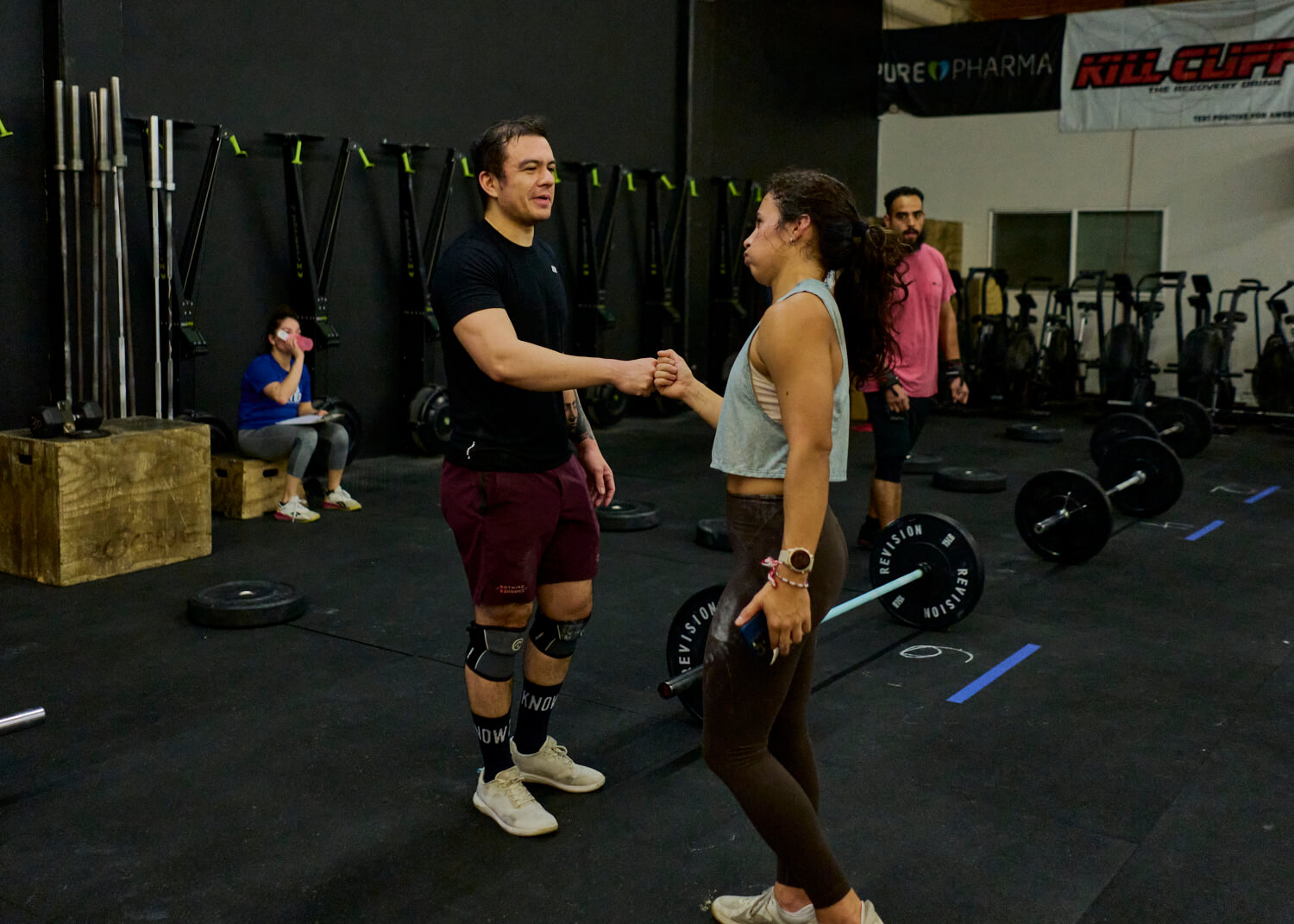
CrossFit has a reputation for community because the structure of the classes creates it. You’re doing the same hard thing at the same time as everyone else in the room. You’re not isolated on a treadmill with headphones on. You know how hard the person next to you is working, because you’re feeling it too. Encouragement becomes natural in that environment — it doesn’t need to be manufactured.
At ESTLR, we’ve had members who came in as total strangers and left as training partners, friends, and in a few cases, actual business partners. The Arts District is a neighbourhood of people who take their work seriously. The gym reflects that.
You don’t have to be social to train here. You can come in, do the work, and leave. But if you engage with the people around you — which tends to happen naturally after a few classes — you’ll find the community aspect is one of the main reasons people keep showing up consistently when their own motivation would otherwise let them down.
How CrossFit in LA is Different from a Standard Gym
If your reference point for gyms is a standard commercial gym — machines, free weights, cardio equipment, a few personal trainers walking the floor — CrossFit is a meaningfully different experience.
- Coaching, not access – When you pay for a CrossFit class, you’re paying for a coach who is actively running the session — not just a facility you can use. The difference in what you learn and how fast you progress is significant.
- Structured programming – Commercial gym members often spend more time deciding what to do than actually doing it. CrossFit removes that entirely. You show up. The workout is on the board. You do it.
- Group accountability – Statistically, people who train in groups are more consistent than people who train alone. The scheduled class format means you book a time, show up, and train with people expecting you there.
- Functional movements – CrossFit’s programming is based on movements that reflect how the human body actually works — squatting, hinging, pulling, pushing, carrying. The results carry over into real life in a way that isolated machine training doesn’t.
That said, CrossFit is not for everyone. If you prefer completely self-directed training with no coaching component, our open gym membership is the right fit. If you want individual attention without the group, personal trainingis available. The point is: there’s a version of serious training at ESTLR for whatever you’re after.
The First Three Sessions: What to Expect Week by Week
Most people judge CrossFit based on their first class. That’s understandable, but it’s not the right data point. Here’s a more accurate picture of how the first three sessions typically unfold:
Session 1: Orientation and Surprise
Your first session will feel unfamiliar. The format is different from anything you’ve done at a commercial gym. You’ll be watching other people more than usual, trying to figure out what’s happening, and probably scaling most of the movements. You’ll finish more tired than you expected and more sore the next day than makes sense for how hard you thought you worked. This is normal. Your nervous system is being asked to recruit muscles it hasn’t used in this combination before.
Session 2: The Real Work Begins
Your second session is harder than the first in a specific way: you now know how hard the workout is going to be before it starts. The fear has become something more specific — anticipation. This is the session where most people find out whether they actually want to do this. Most do.
Session 3: The Click
By the third session, the format feels familiar. You’re watching the board with some understanding of what it means. You recognise a few faces. You’ve had a coach correct your form on something and felt the difference it makes. The workout is still hard, but the hardness starts to feel purposeful rather than overwhelming. This is the point most people decide to join.
This is precisely why our $25 trial is three sessions , not one. One session tells you very little. Three sessions tells you almost everything you need to know about whether CrossFit and ESTLR specifically are right for you.
The Best Time to Start Was Six Months Ago. The Second Best Time is Now
Most people who are reading this have been thinking about starting for longer than they’d like to admit. The research phase is fine — but at some point, the next step is walking in.
If you’re in Downtown Los Angeles, the Arts District, or anywhere else in DTLA, ESTLR Athletics has been here for twelve years. We’re at 431 S Hewitt St — free parking, showers, full coaching team, all levels welcome.
The $25 / 3-session trial is the lowest-friction way to find out if this is for you. Three real coached sessions, no auto-enrollment, no pressure. If it’s not the right fit, you’ve lost $25. If it is, you’ve found something that changes how you feel every week for the foreseeable future.
We’ll see you on the floor.
Frequently Asked Questions
Not sure where to start, or have questions about memberships? Get in touch with our team today, and we will help you find the perfect path for your fitness goals.